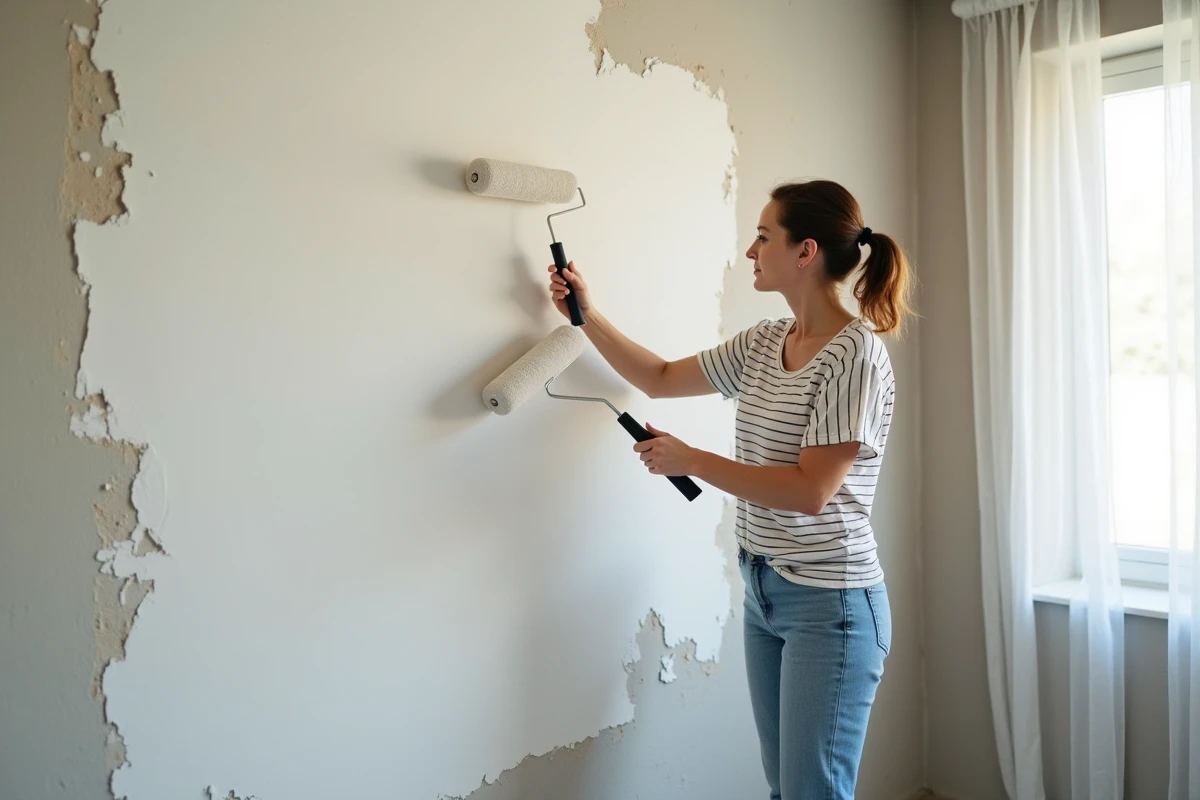
One-coat paints often promise a flawless result but struggle to hide significant cracks and holes. Some formulas, although presented as universal, prove ineffective on porous or brittle surfaces.
Moisture resistance, adhesion capacity, and compatibility with old coatings vary significantly from one product to another. Given the diversity of products, a suitable selection becomes essential to avoid touch-ups and optimize the durability of the work.
Why damaged walls require special paint
Damaged walls are not trivial: cracks, stains, moisture, impacts, peeling paint, reliefs, microcracks are all reminders left by time or repeated use. Repainting a damaged wall is never a simple decorative act. It involves addressing concrete, sometimes multiple, problems that require much more than just a coat of color.
In most cases, a renovation coating is necessary to fill, smooth, and prepare the surface before any painting. Sometimes, applying a glass fabric helps to hide small cracks while permanently reinforcing the wall. On more marked surfaces, thick wallpaper or expanded vinyl can camouflage irregularities without requiring extensive work.
A covering paint for damaged walls stands out due to its formulation: thick, very opaque, with real masking power. Opting for a matte finish minimizes the appearance of defects, while a satin or glossy finish tends to highlight every imperfection. For humid rooms, select products designed to resist water and inhibit mold growth.
Given the variety of problems and the multitude of solutions, restoring a damaged wall requires rigor and discernment in product selection. The substrate, the extent of the defects, and the room’s usage influence every decision. To go further, the page ‘Choosing the right paint to renovate a damaged wall’ analyzes the technical criteria to consider.
What criteria to prioritize when choosing truly covering paint?
When selecting a covering paint suitable for a damaged wall, several parameters make a difference. First, the composition: a thick, opaque formula better masks reliefs and microcracks. Acrylic paint stands out for its quick drying time and versatility, usable in most rooms, even humid ones. Glycero effectively resists moisture, but its persistent odor and emissions require good ventilation.
Finish and substrate preparation
To guide the choice of finish, here are the options to consider based on the desired results:
- The matte finish effectively smooths out small irregularities and remains the best choice for masking defects.
- The satin or glossy finishes require a perfectly smooth wall, as they accentuate every relief or roughness.
Applying a primer or undercoat promotes adhesion and a uniform finish. The quality of preparation, from cleaning to sanding to filling, directly influences the success of the work, regardless of the product chosen for the renovation.
The budget to consider varies depending on the chosen solution and the condition of the wall, with a common range between 35 and 70 €/m². Take into account the room’s purpose: bathrooms and kitchens require washable paints or specific ones to withstand humidity. The choice of color and texture also affects the perception of space, brightness, and atmosphere. Specialized guides help decipher each criterion according to the actual needs of the project.
Practical tips for successfully applying paint on an uneven wall
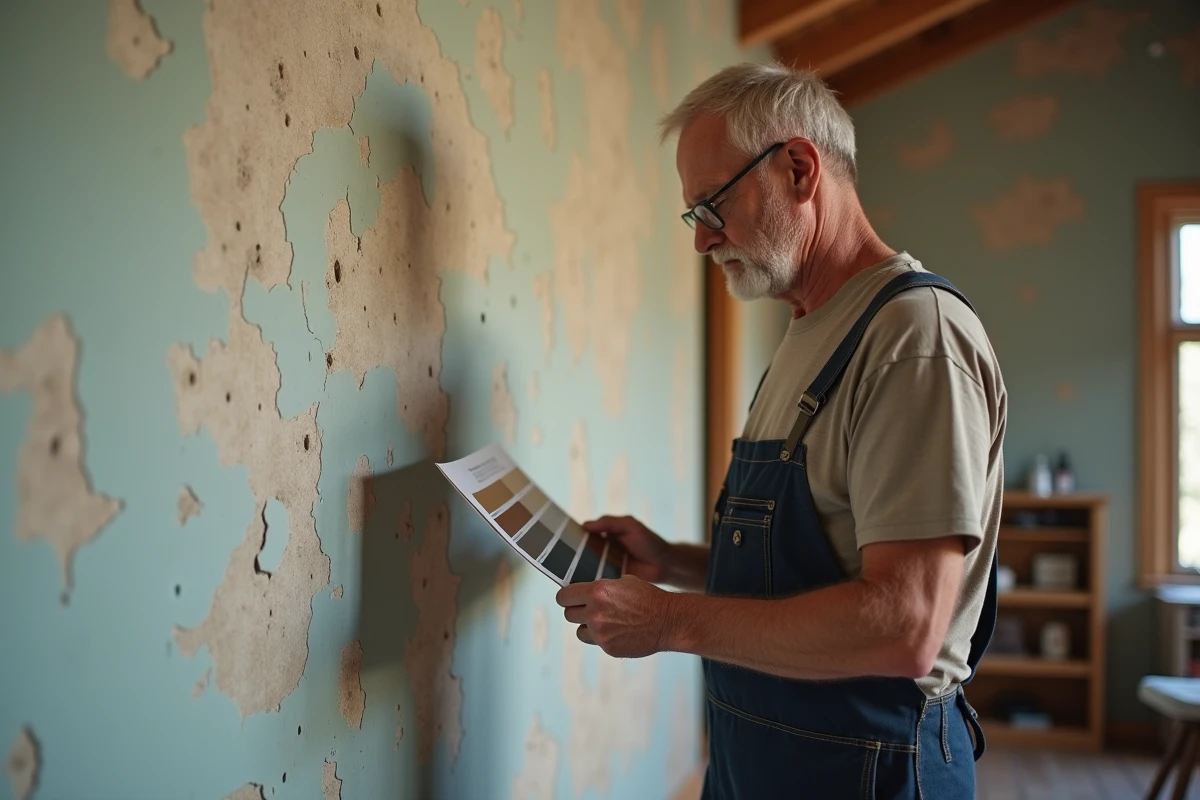
First and foremost, pay special attention to the preparation of the substrate. The condition of the wall dictates every step: dust, residues, or old peeling paint hinder the adhesion of the new coating. A thorough cleaning is essential, followed by filling each crack or roughness with a renovation coating. This phase, sometimes underestimated, determines the paint’s ability to mask defects.
Sanding refines the surface and creates a uniform base. Use a sander or sanding block on treated areas to achieve a homogeneous substrate, ready to receive the primer. This plays a key role: it unifies the background and optimizes the durability of the finish. Even with a covering paint, this step should not be overlooked.
Protect your workspace with tarps and tape to avoid any splashes on floors or baseboards. For materials, favor a medium-pile roller to spread paint over large areas, and a brush for corners or details. Apply the paint in two crossed coats, respecting drying times: this patience always pays off in the final appearance.
If the wall has many irregularities, glass fabric is a reliable solution to permanently mask small cracks before painting. Professionals often recommend this approach for a solid and lasting renovation.
Ultimately, a well-renovated damaged wall does not just erase the traces of the past: it gives the room a strong presence, ready to welcome new moments of life.