Distinguishing a snake’s droppings from those of a bird or small mammal in the field poses a concrete problem for any observer. Recognizing snake droppings relies on a few specific visual criteria, but their reliability decreases as the sample becomes old, dry, or fragmented. This article analyzes exactly this gap between theory and the reality of the field.
Old and Fragmented Droppings: The Pitfalls of Field Diagnosis
Most identification guides describe fresh snake droppings, with their two well-visible components. In the field, the situation often differs. A dropping exposed to the sun for several days loses its white part (urates), which disintegrates or detaches. Without this two-colored clue, the dropping then resembles that of a small mammal.
A fragmented sample further complicates diagnosis. Insect passages, rain, or trampling by other animals disperse the material. Sometimes only a brown-black fragment remains, without a recognizable shape, visually indistinguishable from a shrew or field mouse dropping.
The most common mistake is to rely solely on color. However, color varies according to the snake’s diet and the age of the dropping. A dark brown dropping from a grass snake that has consumed a rodent can be confused with that of a juvenile marten once dried. To reliably identify snake droppings, multiple criteria must be cross-referenced simultaneously, never just one.
Snake, Bird, or Mammal: A Table of Distinction Criteria
The most common confusion is between snake droppings and those of birds. Both contain a white part (urates for reptiles, uric acid for birds). The following table summarizes the observable distinguishing criteria visible to the naked eye.
| Criterion | Snake | Bird | Small Mammal |
|---|---|---|---|
| General Shape | Elongated, sometimes twisted | Pasty, without defined shape | Granules or short sausages |
| White Part (Urates) | Compact mass attached to the dark part | Liquid splash mixed in | Absent |
| Plant Fibers | Absent | Rare (sometimes seeds) | Often present |
| Visible Prey Remains | Scales, bones, fur | Thin bones, insect shells | Rarely |
| Appearance After Drying | Solid brown-black fragment | Friable whitish crust | Dry and hard granule |
The most reliable criterion remains the presence of urates in the form of a compact and separate mass, not mixed with the rest as in birds. In mammals, this white component simply does not exist.
What to Look for When Urates Have Disappeared
When the sample is too old to retain its urates, two clues remain usable. The first is the presence of undigested prey remains: rodent fur, lizard scales, bone fragments. These elements are typical of a predator that swallows its prey whole, which snakes do but not comparable-sized mammals.
The second clue is the total absence of plant fibers. Reptiles are strictly carnivorous. A dropping containing even the slightest trace of plant material points towards an omnivorous mammal or a granivorous bird.
Environmental Clues to Enhance Droppings Identification
The dropping alone is not always sufficient. The context of discovery provides additional clues that reduce the risk of error.
- The location: snakes often defecate near their shelter (rock piles, stumps, walls). A dropping found in open areas, on a branch or pole, is more likely from a bird.
- The molting trace: the presence of a shed skin nearby confirms the passage of a snake. This cross-reference is the most reliable in the absence of fresh droppings.
- Movement traces: a winding track in dust or mud, even partial, associated with an elongated dropping, reinforces the reptile hypothesis.
- The season: in winter, at our latitudes, snakes are inactive. A fresh dropping found between November and February likely does not come from a reptile.
Grass Snake and Viper: Comparable Droppings
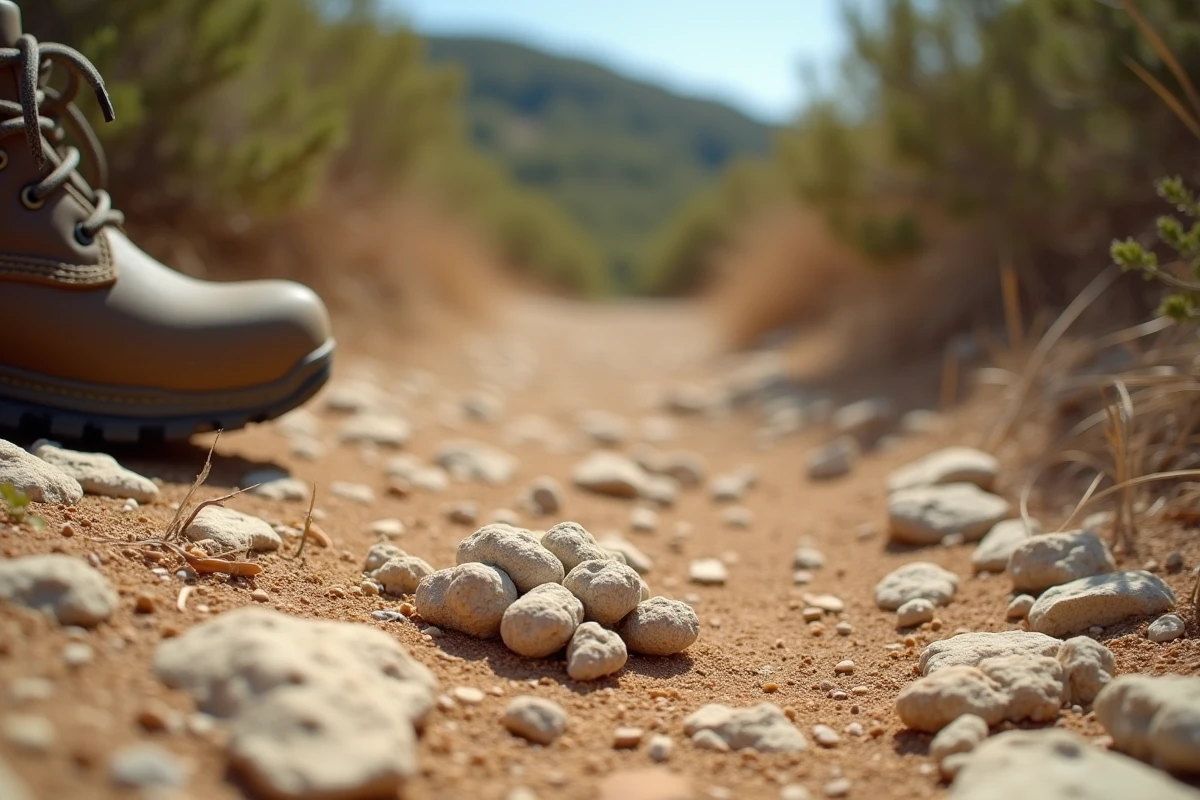
Distinguishing the droppings of a grass snake from those of a viper with the naked eye is very difficult. Both genera produce droppings of similar structure. Size can give a rough indication (collared grass snakes reach larger sizes than asp viper), but this criterion remains unreliable without knowing the age of the animal.
The diet sometimes leaves a signature. Grass snakes frequently consume amphibians, whose thin and fragile bones can be found in the droppings. Vipers feed more on small mammals, with more robust fur and bones. However, these differences require careful examination, sometimes with a magnifying glass.
Practical Field Identification Method
Reliable identification of snake droppings in nature relies on a simple three-step protocol.
- First, look for the white component (urates) attached to the rest of the dropping. Its presence in a compact and non-liquid form immediately points towards a reptile.
- Next, examine the visible content: absence of plant fibers and presence of animal remains (fur, scales, bones) confirm a predator that swallows its prey whole.
- Cross-reference with the context: proximity to a rocky shelter, molting trace, period of snake activity in the region.
If two of these three criteria converge, the snake hypothesis is strong. A single isolated criterion, especially on an old dropping, does not allow for a conclusion. Cross-referencing clues remains the only reliable method when the sample is degraded, which represents the majority of cases encountered in the natural environment.