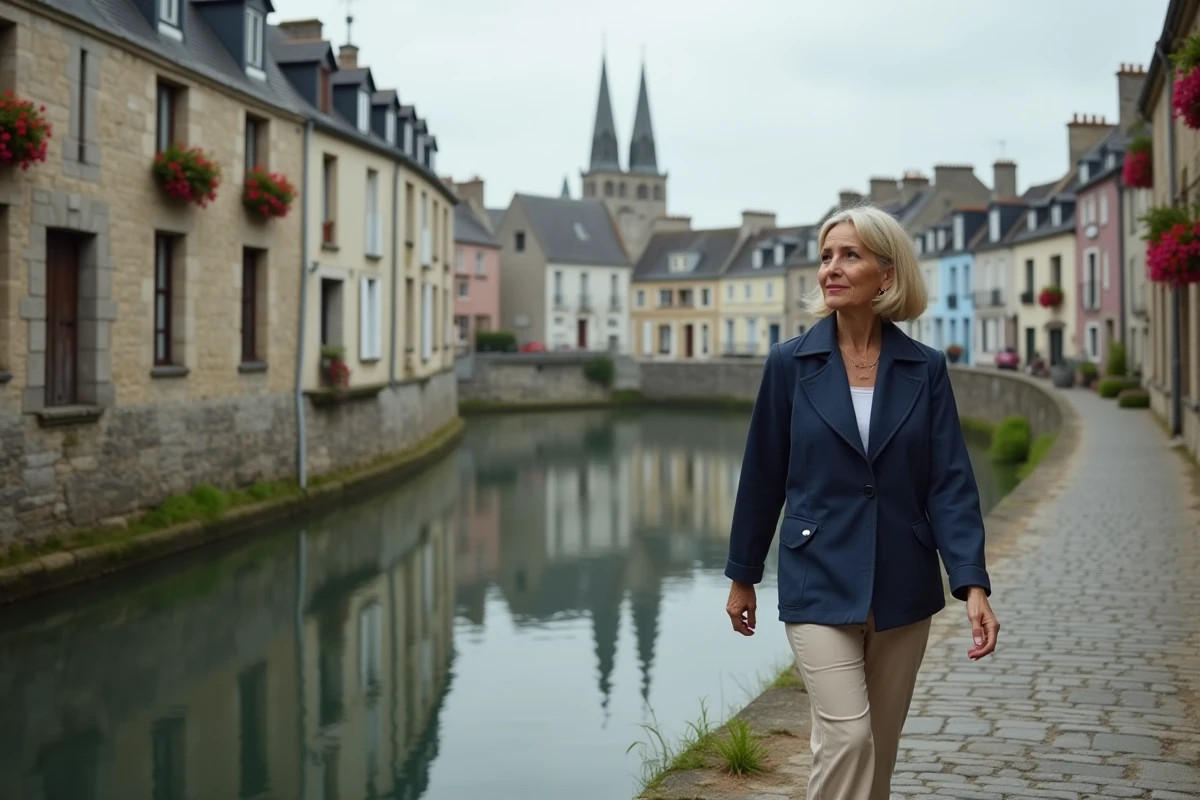
Quimper is the prefecture of Finistère and the historical heart of Brittany’s Cornouaille. Crossed by the Odet and its tributaries, the city concentrates a dense built heritage, an active cultural scene, and a natural setting accessible on foot from the center. Understanding how neighborhoods, museums, and daily life are articulated here allows one to gauge what this city truly offers its residents and visitors.
Neighborhoods of Quimper and Urban Organization
The city has developed around three distinct historical cores, each linked to a watercourse. The Locmaria district, downstream from the Odet, is home to the Quimper faïence workshops, a production that has shaped local identity for several centuries. The old town, tightly knit around the Saint-Corentin Cathedral, features pedestrian streets, half-timbered houses, and independent shops.
The Terre au Duc district, on the opposite bank, developed later. Its layout differs: wider streets, 19th-century buildings, covered markets. This distribution into three hubs creates a natural flow between banks and bridges, making the city navigable even without a map.
For residents, this compact organization means that most services, shops, and cultural venues remain accessible without a car. The banks of the Odet serve both as a daily promenade and a link between neighborhoods, an asset that larger urban areas struggle to provide. Those who wish to learn more about So Quimper will find a comprehensive overview of local resources related to the region’s dynamism.

Quimper Museum and Exhibition Venues to Visit
The Fine Arts Museum, located at Place Saint-Corentin, constitutes the city’s main artistic collection. Its collections cover European painting from the 14th to the 20th century, with a strong focus on the Pont-Aven school. The canvases of painters who worked in Brittany are displayed alongside older Flemish and Italian works.
The Breton departmental museum, housed in the former episcopal palace, takes a different angle. It documents the history, archaeology, and folk arts of Cornouaille. Costumes, furniture, ceramics: each room recounts a facet of Breton daily life.
Faïenceries and Open Workshops
In Locmaria, the Henriot faïenceries offer guided tours of their workshops. Observing the throwing, hand-painting, and firing processes helps to understand why this production remains tied to the image of Quimper. The so-called “petit breton” patterns are recognizable among all, but contemporary collections move away from this folkloric style to explore more graphic forms.
The city also hosts temporary exhibitions in less expected venues: deconsecrated chapels, media libraries, associative galleries. This network provides a cultural density greater than one might assume for an urban area of this size.
Jardin de la Retraite and Green Spaces in the City
The Jardin de la Retraite, backed by medieval ramparts, gathers subtropical species that benefit from the microclimate created by the stone walls. Palms, tree ferns, and camellias grow just a few meters from the city center. This contrast between granite walls and lush vegetation surprises visitors who do not expect it.
- The Jardin de la Retraite can be explored in about twenty minutes, but its slope offers a plunging view over the roofs of old Quimper and the cathedral.
- Mont Frugy, a wooded hill accessible from the center, offers short trails and a wide panorama of the confluence of the Odet and the Steir.
- The landscaped banks of the Odet connect the city center to the Locmaria district via a shaded promenade, usable year-round.
For a city of this scale, having three major green spaces within a ten-minute walk from the historic heart is a tangible advantage, both for quality of life and for weekend visitors.
Cultural Life and Festivals in Cornouaille
The Festival de Cornouaille, held every summer, is the most recognized event. It combines Breton music, traditional dances, and concerts open to broader aesthetics. For several days, the city center becomes an open-air stage where festoù-noz and street performances follow one another.
Outside this period, the programming of the Théâtre de Cornouaille, a national stage, covers theater, contemporary dance, and classical music. The Pavillon hall hosts concerts of current music. This complementarity prevents the syndrome of a city with a single event.
Local Cuisine and Markets
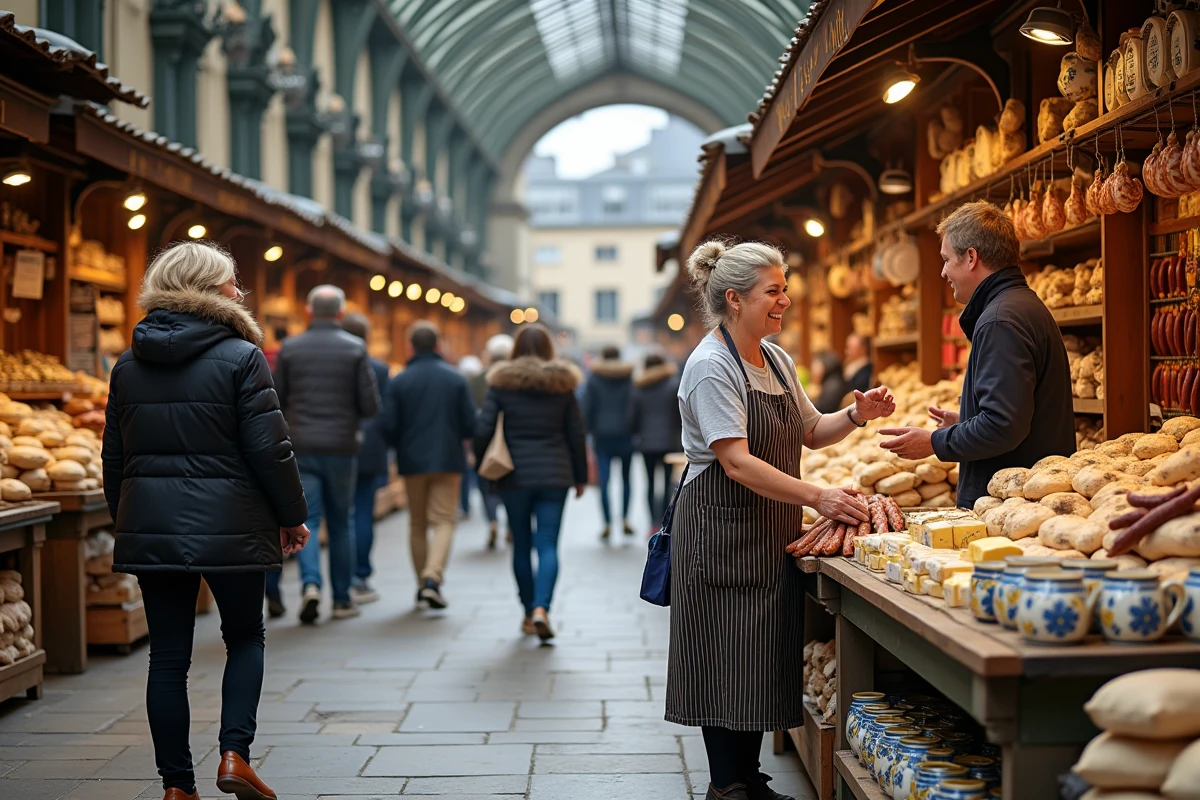
The covered market of the Halles Saint-François operates several days a week. Here, one can find fish and shellfish landed just a few kilometers away, buckwheat pancakes, farmhouse ciders, and kouign-amann, a pastry originating from the Douarnenez region but widely adopted in Quimper. The crêperies in the old town remain a strong marker of local life, provided one strays from the most touristy addresses.
- The dry cider from Cornouaille has a specific designation that guarantees a dry and tannic taste profile, different from the sweet ciders of Cotentin.
- Artisanal fish canneries located along the nearby coast supply the shops in the center and the markets.
- Salted butter, omnipresent in Breton pastry and cuisine, is not a cliché: it truly structures the flavor of local dishes.
Quimper as a Starting Point to Visit Finistère
The geographical position of Quimper, halfway between the southern coast and the Pointe du Raz, makes it a logical base for exploring Finistère. The bay of Douarnenez, the cap Sizun headlands, and the beaches of the bay of Concarneau are all a short drive away. The Odet itself extends as a ria to the sea, navigable during seasonal river cruises.
Quimper’s train station, the terminus of the TGV line from Paris, simplifies access for visitors without a car. A bus network serves the surrounding municipalities, although a car remains more practical for reaching isolated coastal sites.
Quimper is not a museum city frozen in a postcard setting. The regular cultural activity, the quality of urban green spaces, and the immediate proximity to the Breton coastline make it a place where heritage and daily life overlap without artifice. It is probably this overlap that retains those who had only planned a quick stop.