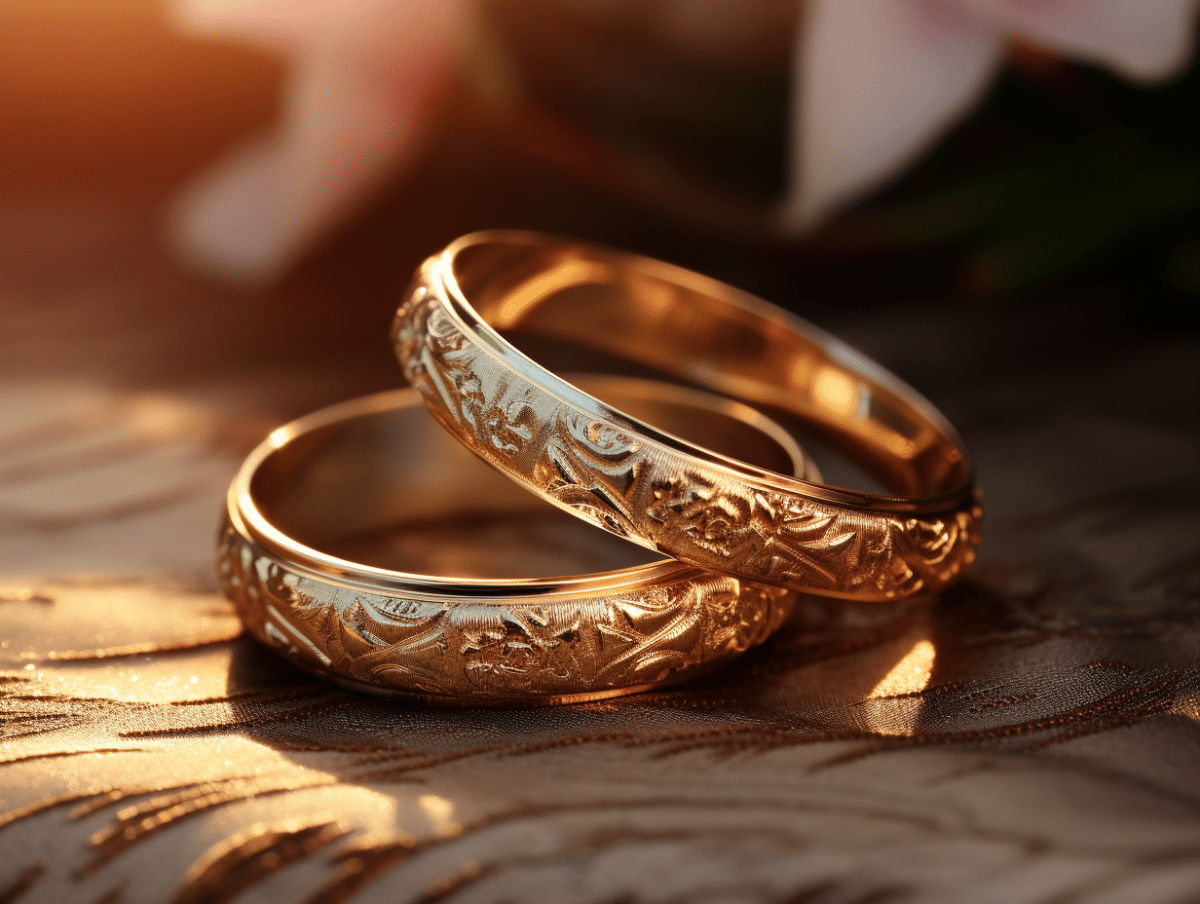
Wedding rings, these bands exchanged during nuptial ceremonies, are steeped in history and symbolism. Their origin dates back to antiquity, where they symbolized a legal contract between spouses. Over time, the wedding ring has become the universal symbol of eternal love and mutual commitment. Traditionally made of gold, a precious metal resistant to the erosion of time, they embody the continuity and strength of the marital bond. From ancient Egypt to the present day, the perfect circle of the ring is a constant reminder of the infinity of love, an endless connection that unites two people.
The Historical Origins of the Wedding Ring
Understanding the symbolism of wedding rings involves a return to the roots of this age-old tradition. The history of the ring takes us to ancient Egypt, the cradle of civilization and a pioneer in the use of the ring as a marriage contract. The Egyptians, with their cosmic vision and refined art, saw in the circle of the ring a sign of infinity, a mirror of the unbreakable union between two beings. This piece of jewelry, often crafted from modest materials, was imbued with sentimental and legal value, sealing the agreement between families and spouses.
Over the centuries, the wedding ring has traveled, carrying with it this symbolic weight through the social and cultural evolution of peoples. The Middle Ages, a pivotal period in Christian Europe, witnessed a notable evolution: the ring migrated from the left hand to the right hand, following a rite of passage where faith was closely intertwined with the marital vow.
The marriage tradition has thus been perpetuated, the ring evolving to adopt the customs and practices of different eras. The marriage commitment is materialized by this ring, whose original simplicity sometimes gives way to more ornate creations, incorporating precious metals and gemstones, reflecting a social status or a desire for ostentation.
However, beyond the vicissitudes of history and aesthetic variations, the symbol of love that the ring represents remains unaltered. Each ring, whether simple or elaborate, carries a promise of eternity, a hope for shared happiness, a pact of love that transcends the ages. The tradition continues, enriched by its past, always vibrant in the present.
Meanings and Symbols of the Ring Across Cultures
The ring, an object of value and emotion, holds multiple meanings at the crossroads of cultures. In the workshops of jewelers, artisans of love, these rings are forged to seal unions. Throughout the ages, each civilization has infused the ring with its beliefs and values. Gold, a luminous and unalterable material, has established itself as the preferred metal to symbolize the purity and richness of feelings.
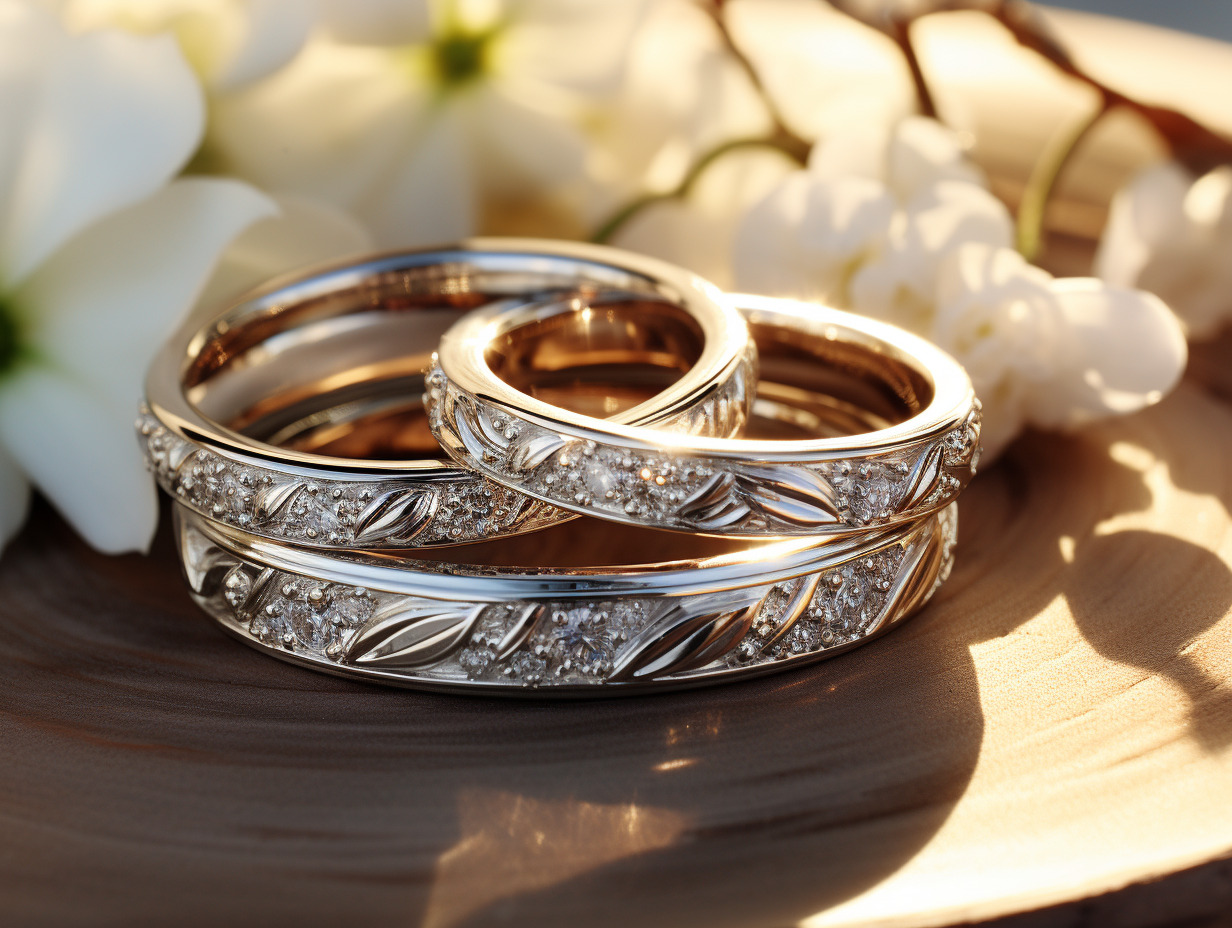
Noble metals, such as palladium and platinum, as well as various shades of rose, white, yellow, and even black gold, offer a palette of expressions for rings. Each metal carries its own symbolism, chosen by the future spouses to reflect their story. Rose gold evokes softness and warmth, while white gold promises modernity and elegance.
The diamond, for its part, shines with its timeless brilliance in the setting of the rings. A symbol of purity and durability, it is evaluated based on color, clarity, weight, and cut—criteria that confer to the stone its unique character. The engagement ring, often adorned with a diamond, precedes the wedding ring, announcing the commitment and promise of eternal love.
The circle as a symbol of eternity is a universal constant. It reminds us of the infinite cycle, with no beginning or end, evoking the continuity and permanence of the commitment made. Wedding rings, beyond their material value, embody this commitment, this desire to build together, day after day, a shared future. They are the visible testimony of a life choice, a journey taken together, in mutual fidelity and trust.